The attack on Notre-Dame by the Court of Miracles
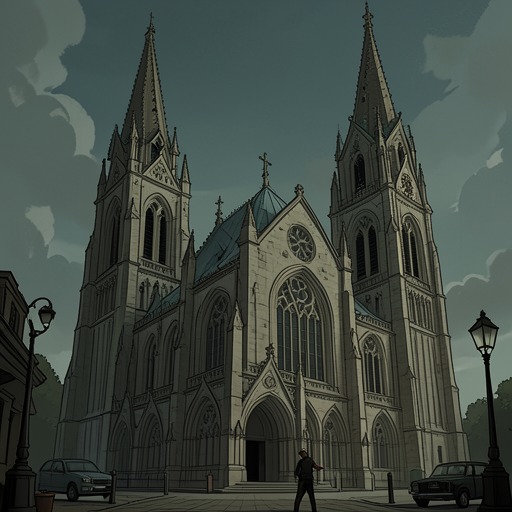
The Hunchback of Notre DameThe attack on Notre-Dame Cathedral by the Court of Miracles outcasts is both a rescue attempt and a siege that exposes the conflict between church sanctuary, royal justice, and popular resistance. Clopin Trouillefou presents the assault as a defense of Esmeralda, condemned to death and sheltered in the cathedral, but the crowd’s hopes of plunder quickly become inseparable from that stated cause. Against them, Quasimodo improvises a defense from the building itself. The battle briefly turns the cathedral from refuge into fortress, while leaving its defenders and the woman at its center in immediate danger.
Background and Stakes
In the medieval order described in the novel, sanctuary offered a condemned person protection within a church, but not freedom to leave: outside its boundary, the person again faced the authorities and punishment. The privilege could also be contested or overridden through legal and political power. Paris itself was divided among jurisdictions: the island, the right bank, and the left bank had distinct authorities and institutions, while the provost of Paris exercised royal jurisdiction over the whole. Against this divided legal landscape, a church refuge could stand apart from ordinary justice without being beyond its reach.
Esmeralda’s sentence makes that tension immediate. A court orders that she be publicly brought before Notre-Dame Cathedral and then taken to the Place de Grève for execution, along with her goat, on charges including sorcery and the murder of Phoebus de Châteaupers. She is subsequently under the church’s protection. Clopin’s accusation is that the bishop will permit the authorities to seize her again, making the attackers’ demand for her return a challenge to both the threatened execution and the church’s obligation to shelter her. The event therefore begins with a dispute over who can claim custody of a condemned person, not simply with a sudden assault on a building.
Muster and Ultimatum
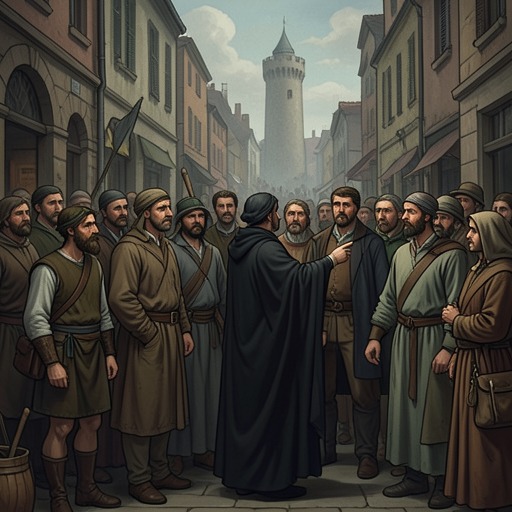
At midnight, Clopin’s call sends the outcasts rushing from the tavern. In the darkness of the Court of Miracles, the assembled crowd speaks in low voices, and weapons glint among them. Once the band has formed up, Clopin climbs onto the church-square parapet and addresses the bishop, declaring that Esmeralda is their sister and that the church must keep her safe. He makes the choice stark: return her, or the outcasts will take her and sack the church. A pitchfork bearing meat is planted as their banner, turning their challenge into a public claim of possession.
Clopin then orders the group forward. About thirty men equipped with hammers, pincers, and iron bars set to work on the principal door, while others crowd the steps to help or watch. The door resists their tools. When a massive timber suddenly falls from above, the attackers scatter and leave the entrance. Clopin regains their nerve by treating the fallen beam as a battering ram. Hundreds of arms raise it and drive it against the door; the cathedral shudders, but the entrance holds. Stones begin to fall from the façade, and the assault becomes a contest between the crowd’s repeated blows and a defense that they cannot yet see.
Quasimodo’s Improvised Defense
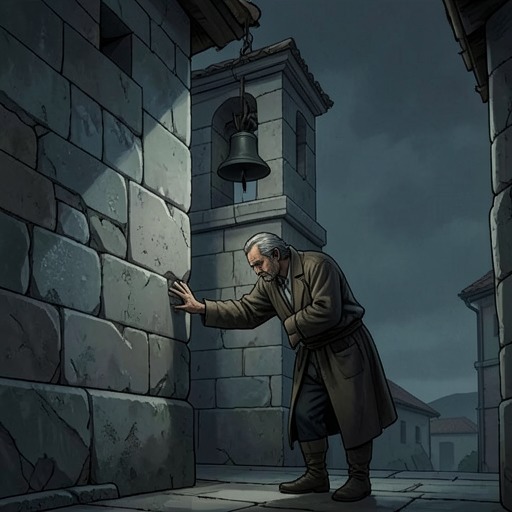
The narrator reveals that the resistance comes from Quasimodo. From the platform between the towers, he has watched the crowd assemble and recognized that the church door may be breached before he can sound an alarm. Repair work in the south tower gives him another means of defense: its lower rooms contain stone blocks, rolled sheets of lead, laths, and heavy beams. He pushes the longest beam through a loophole and sends it down from a height of 160 feet. The fall drives the attackers away from the church entrance and gives him time to prepare further obstacles.
As the crowd returns to the door, Quasimodo stacks plaster, stones, rough blocks, and the masons’ tool sacks at the edge of the balustrade, sending material down onto the attackers. When this does not stop them, he finds two stone gutters that empty above the main entrance. He builds a fire from a fagot, laths, and rolls of lead by their openings. The attackers, no longer watching for falling stones, have gathered close to the door for another attempt. Their talk and anticipation reveal that the promised rescue is not the only motive: many are eager to seize the church’s accumulated wealth, and Esmeralda’s plight serves some of them as a pretext. Quasimodo’s next defense sends streams of melted lead down from the building, forcing the crowd to retreat once more.
Renewed Assault and Reversal
A later approach opens a new route to the gallery. Jehan Frollo du Moulin arrives dragging a ladder, and the outcasts raise it against the church. In heavy armor, carrying a crossbow, Jehan climbs first; others follow, rung by rung. On reaching the gallery, he encounters Quasimodo concealed behind a statue. Before another attacker can gain the platform, Quasimodo seizes the ladder’s uprights, pulls it away from the wall, and casts the ladder and its crowded line of climbers back into the square.
Jehan’s death changes the crowd’s temper. Shame at being held back by one defender gives way to renewed fury. The outcasts find more ladders, knot ropes, and climb the projections of the carved façade, pulling one another upward. The scene makes the cathedral’s stonework part of the assault as well as its setting: the attackers ascend by the very projections that shape its exterior. Torchlight now fills the square, alarm bells sound in the distance, and the mass rises toward Quasimodo’s gallery. He is increasingly unable to hold them off and fears for Esmeralda, while the narrative leaves the confrontation at its height rather than showing its resolution.
Political and Narrative Significance
The attack’s language of sisterhood and asylum does not settle what the crowd intends. Clopin frames the action as protection for a falsely condemned woman and as resistance to a church that might surrender her; the narration, in turn, makes clear that the hope of looting Notre-Dame Cathedral also drives many of the attackers. This friction between proclaimed solidarity and material appetite complicates any simple account of the outcasts as either rescuers or invaders. The same crowd can invoke a threatened sanctuary and assault the church that provides it.
The surrounding political plot widens the meaning of the siege without resolving its immediate outcome. Louis XI has been watching Paris from the Bastille, and a later exchange identifies the attackers as vassals of the bailiff who have long complained about his authority and refuse to recognize him as judge or officer of the highways. The assault thus intersects with resistance to local rule as well as with Esmeralda’s peril. At the center, however, the decisive contrast is between Quasimodo’s solitary, improvised defense and a multitude whose numbers continue to grow: the cathedral gives him height, materials, and refuge to defend, but its walls cannot guarantee that he will prevail.